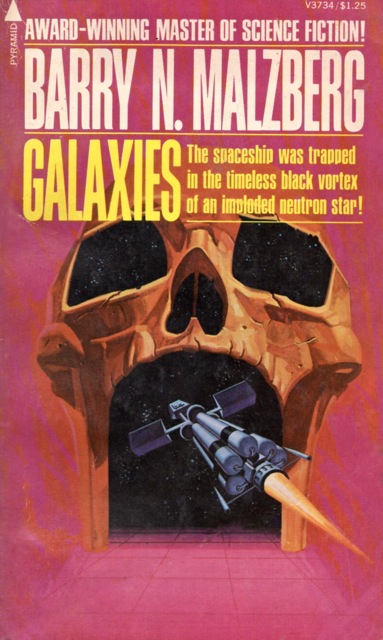
With GALAXIES, legendary misanthrope Barry Malzberg turns in his meta-rumination on the SF genre as a construct, particularly the space opera opus, unraveling and re-wiring the golden-age conventions to power his rusted pandora’s box, an anti-novel also called GALAXIES. However Malzberg-as-writer-as-pseudo-subject can’t seem to figure out the clearest and most linear method to tell his story of an interstellar coffin ship sucked into the black rip of a neutron star, where its lone captain, Lena, can’t seem to figure out what’s reality and what’s reconstruction. Of course, in the timeless limbo, Lena becomes victim to her own timeline (30,000 years, 1000 lives in tandem), her own identity losing shape as the coffin ship descends into what just may be the original black nothingness of the universe. Poor Lena becomes both the sieve and the sponge, the lone speck failing in both time and space while the junkheap cyborgs assisting her journey become nothing more than steel effigies force-fed dialogue programmed from the great Universal Corporation, The Bureau.
This is like the cyanide-pill version of Lem’s SOLARIS as told by an aggravated New Yorker ready to sell off his science fiction collection for sanity alone. Nuance is no longer welcome.
“So there for all of you, so there. All of the pain, the struggle for acquisition, the explanation and metaphor for nothing. A burst of epiphany and then obliteration.”
Not by any means an easy read, this is more like a farewell eulogy to the genre, and we feel Malzberg’s alter-ego stammering away at the typewriter in the suburb of Ridgefield Park, New Jersey ready to deep-six the genre and bury it off-site like someone who never paid their bills on time. Malzberg is the prodigal son of the cynical American New Wave, trying to be inside the circles of Saul Bellow or Philip Roth, but only confining himself well outside the literati, well beyond ragged demarcations of yet another acidic space opera full of ribald sex, cruel hallucination, and of course, the all-consuming ruckus some call Entropy.
The book is dense, Malzberg’s anti-climactic swan song to science fiction. All the perverse pyrotechniques of BEYOND APOLLO and THE FALLING ASTRONAUTS step back for the ruminations of both mapping the universe as an insane and fatal concept, while laying out the groundwork of the failing SF writer who suddenly finds himself hollow, the copperheads of his creation no more than lifeless serpents sucking their own tails and calling it a day.
Oddly enough, there is a light at the end of this salty masterpiece. But knowing Malzberg, it could just be something else altogether, a light as trustworthy as the phosphorescent lure of a deep-sea angler fish.
 Douglas G. Purdy writer. SF. Horror. Crime.
Leave a comment